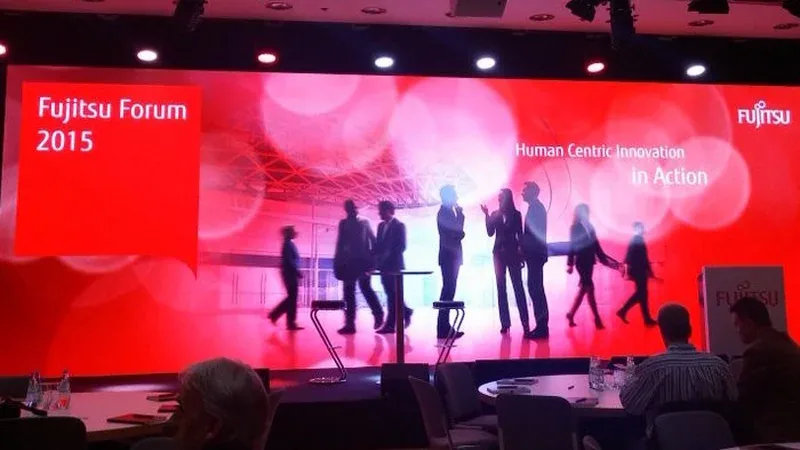
Every year I'm eagerly waiting for the arrival of a larger than usual IT event, in this case it is the Fujitsu Forum, which is the largest IT vendor event in Europe.
It is always good to meet some colleagues, and share thoughts on different topics. For me, R&D topics are always interesting. This is why I'm also curious about the topics of the SC15 event. Unfortunately, the two events take place at the same time, but after the events we can collect information from the slides of the events.
During the Fujitsu event, I'm always waiting for the presentation of Dr. Joseph Reger, to find out what is the corporate strategy, and what new technologies can impact our lives. This year I was really glad to hear the same things which I myself have said many times. We cannot turn away from Open Source softwares. In many areas today we can get much better Open Source components, compared to the ones which we are able to purchase from large vendors. Most of the people think that these softwares are made from hobby programmers, for home use. If anyone takes time and looks around, it is easy to find big developer names in the source codes. Most of the largest company's programmers make their codes available to the public. With the mass of the end users, we get a tester base which none of the largest enterprises are able to finance. Of course, they also share their public beta software, which we later pay a bigger amount for when it is released. If we compare user numbers of a large enterprise product versus an open source software, the open source will always be bigger.
It is a wise vision from Fujitsu in that they don't want to invest large amounts of money to components which are available as an open source. IBM did the same a few years ago, and successfully saved millions in USD. It is always an easier task to extend a good base product with our needs, compared to rewriting everything from scratch.
They announced their application integration platform which helps to integrate the current solutions of any company, to any kind of new sources. This will accelerate the transformation from old legacy systems to the new ones. The new applications which will be built on top of these integration platforms will free new applications from the legacy systems.
Prior to this presentation I have also seen the R&D Visions of Fujitsu Laboratories. These also showed some other important visions to me.
If we want to be free from Moore's law, we need to release the Neumann concept computer systems. We need to discover a new way of computing. Quantum computing is one of these ways.
This direction is important and goes against the current initiative of most vendors. Today everyone wants to handle everything with x86 computers, along with handling everything with software defined components. In the future, I believe much more in an API defined world, when the computing behind the API is not necessarily a computer system, it can be anything.
The third important vision which I have seen is a wider range of appearance of AI, which will be the main focus in the computing industry in the next ten years. Currently we are in a phase where we try to emulate multiple mathematical algorithms with the CPU or GPU, but after we discover efficient technologies, the machine learning speed will exponentially grow.
I had a really interesting discussion on the HPC stand, regarding ML and HPC relations. Finally, we had the same opinion. Today the main problem which limits this area is not the computing power, much more the memory bandwidth. Current x86 processors reach the full memory bandwidth with 6 cores, but the largest core number processor has 18 cores. We can consume three times more memory bandwidth with the current computing power. I hope soon we can be free from these bottlenecks, maybe with Hybrid Memory Cube technology.
If anyone is interested, the presentation can be found on the Fujitsu public web site:
https://www.fujitsu.com/global/microsites/fujitsu-forum-2015/
Now we have again one year until next event announcements.