This week I have a presentation about digital humans. I thought it is worth sharing my knowledge on the topic.
In the last few years, digitization has become the most crucial topic in the IT world. We are digitizing more and more processes and documents; why would it be different from one of the most important corporate resources, the human resource!
As part of my presentation, I invite you on a journey in which I will present the challenges that arise in this regard.
I first started dealing with the topic in 2018. As part of my R&D activities at the Bank, I dealt with several topics that led straight to the digital humans. It’s not hard to collect these because most of them are already part of our everyday lives. Examples are chatbots or automation that eliminates routine work.
The Digital Human was brought to life by a similar motivation as automation. We can hand out routine, repetitive jobs to machines, while we humans can work on tasks that are challenging and varied. Think about how many people burn out in constant monotonous work. For these jobs, in addition to burnout, a more significant concern is that they are challenging to fill. It is precisely along with these thoughts that I have concluded that a digital worker implemented on time can mean tremendous competitiveness in the future.
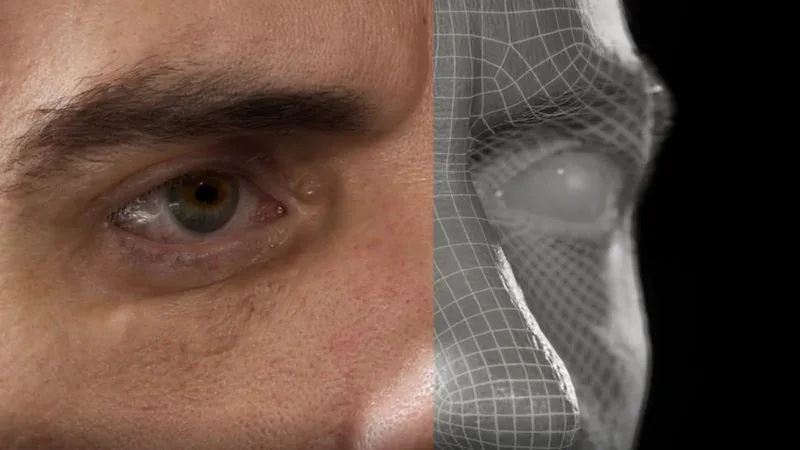
It is essential to clarify what we mean by digital humans - an avatar: A realistic three-dimensional human figure whose intelligence is provided by artificial intelligence, like the lady in the picture.
When we talk about artificial intelligence, most people have apocalyptic visions - like the Terminator from the slide background. I'm an optimist guy - I don't think the situation is that serious. Crowds are terrified that the machines will take away our work. At such times, I always ask if it would bother anyone if they were freed from their monotonous tasks and could engage in creative tasks?
Obviously, the majority immediately give a positive answer. Artificial intelligence has enormous potential. In general, I always use the example of the Internet meant in the 1990s. Whoever had access to the Internet, those have access to the information much faster. The advantage of artificial intelligence has the same importance. Not only access the information faster but also interpreting the information.
Like the Terminator on the previous slide, the robot always comes to mind, but it's worth thinking through what really distinguishes it from robots? What separates us from the machines?
I think more of you have the answer now - the feelings. It is the feelings that make digital humans unique. In their case, they also use a high level of emotional intelligence, which, in many cases, makes communicating with them more human than what we experience when communicating with people. That's precisely why their application is brilliant compared to a chatbot. How many of us have already noticed that an email we sent was not interpreted the way we imagined?
It is no coincidence that if I experience something similar, I would also ask my colleagues to clarify the disagreement personally. Why does personal communication work better than a phone conversation? Because we use a lot more of our senses than we do in electronic communication. Body language, tone of voice, facial expressions all help us convey the information we want. There are some exemptions like Steven Segal, but those minors.
We also get a lot of feedback from the other party. We can shape how we pass the information, and we can react early if we see some problems.
In many cases, the number one source of conflict is inadequate communication. I think it has now become apparent to you that the digital worker can perform the tasks, but it surpasses the traditional workers in many cases. Just think it through, in how many cases do employers devote energy to assessing the emotional intelligence of candidates and colleagues while filling a position?
There are several benefits to utilize digital humans! They can work 24 hours a day. In all cases, they perform their duties in the needed capacity. They can be reproduced as many we need. When the same routine tasks need to be performed, there is no queuing, no sharing of attention. Think of an example in New Zealand where a digital geography teacher was created. Each student received their own copy from the teacher. The teacher teaches one student at a time, and they keeping pace as they learn the materials. Through continuous emotional analysis, they know exactly if the student does not understand what the digital teacher teaches. They can tell topics differently until the information goes through. Since there is one individual connection, so there is no cell phone in class, we can be sure that the curriculum is actually focused.
They have no prejudices, which means that they serve everyone in the same way, regardless of gender, age, wealth, or appearance. This is a vital aspect! It is precise that we are human for many jobs that prevent us from doing the job correctly!
To create avatars that touch even more deeply, it is not enough to perceive feelings or related feedback; they need to show feelings!
Next, we need to under the feelings and their meanings:
Anger is one of the most basic feelings. Basically, everyone categorizes it as unfavorable at first, but I would like to present your complimentary view. Instinctive. Just think of the phrase: My brain is flooded with rage. Anger helps us to say a clear yes or no. It helps you make decisions. It helps us take what we say seriously. It induces action or causes activities to stop. It helps us to be active and energetic with clear goals.
Sadness helps to let go of things and surrender ourselves to the flow of life. It helps to open our hearts to the power of love. It allows us to accept things we don't like, but they are out of our control. It helps in letting go. We recognize and accept our helplessness.
Like anger, fear can be positive in many cases. Separates the known from the unknown. Surprisingly, we need it for a lot of things. It helps us be creative. It helps to find possible solutions when we get lost in an unfamiliar area. We discover new things because of the desire for adventure. It helps us face insecurity and go beyond our borders.
Joy plays a particularly important role in our lives. It helps us enjoy the moment. It helps us take things with humor. It helps us to be energetic and understand our purpose what we live for. It helps inspire others while we develop charisma. At the same time, joy has its downsides. The illusion of seeing something more positive by joy than reality.
Shame also plays a critical feeling. It is used for self-reflection in a basically healthy situation, instead of self-destruction. We need it to behave appropriately in a given situation. I recommend Vivien Dittmar, who has been researching human feelings for a long time, for those who are more deeply interested in the subject.
Now that we've gone through the basic concepts. You can imagine how difficult to have these feelings in artificial intelligence.
Let's jump into the details. Who now has the motivation to start this kind of project will guide you on preparing for such a project. For me, working with a company that has tremendous skill was shocking because there were a lot of issues that we didn't think about in the beginning. I think it is useful for everyone to gather this information in advance so that the project can focus on the essentials.
The first thing we have to dream about is the character! If our company was embodied in one person, what would it be like? In this, the employer brand helps a lot, but it is a challenge to represent different cultures. We have to identify the target group? Who do we want to serve? The needs of a young Z-generation member are different from those of a conservative retiree. Here we have to dig very deep when we dream of the character! The more detailed the character, the more lifelike it will be! Here are a few examples that are good to answer:
What is it you doing in their free time?What kind of music does it listen to?What do its parents look like?Where was it born?What sports does it do?What is its favorite food or drink?An excellent example of the characters in the background is Captain America, who was made the epitome of America in the movie during World War II!
Similar to movies, here we create dialogues for the dialogues for which the worker is destined. In dialogue, what matters is what we say and what emotions we express in what we say.
Just remember the dubbed movies in the early '90s. We understood there, but it was funny as the narrator talked without any emotion.
We need to construct the scene (s) precisely step by step. It may seem simple at first, but the more options we take along that can be real, the better it will work during live operation. This was the next point at which I realized that creating a digital worker goes far beyond IT. In connection with the previous slide and this slide, we can understand how jobs are transformed even when we think it is an IT-related task.
Crucial for the dialogs to cut to a minimum functionality. More function you put, it will make your project significantly complicated.
Once we're past creating the character and the dialogues, the implementation is the next step. Once we've fed everything into our digital human, we can start the testing. It's a lot harder than any IT testing task than we've done so far. It is not enough to play the situation; we also have to imitate the feelings we expect from our digital human's customer. You need much more acting skills than IT. We need to improvise to try as many situations as possible that can occur. Currently, this is also a task that is not replaced for a long time by a machine.
During the testing, a lot of experience is gathered, which we were not prepared for. It is advisable to feedback these. We go back to iterations until the dialogue is made. Most of the time from the project is taken by these iterations. In many cases, focus groups or external actors are used during testing, so we can spontaneously get to branches we weren't prepared for. It is advisable to continue the process until we no longer encounter a big surprise. We also get a wealth of data during use, which can add tremendous value to our future product developments.
Once everything is fully working as expected, we can add additional content to the functionality. Thanks to the new content, we will be able to use the avatar more and more versatile. As we get routine in use, the development will get faster and faster. They give very positive feedback about most places where avatars are already used. They have achieved a much higher degree of customer engagement than they have so far used chatbots. Implementing companies are all further developing their digital colleagues.
What does the future hold? It's uncertain in any case, but if you trust me, I'll envision the following. The digital worker will receive a holographic visualization. As mixed reality devices find their market, they will be with us virtually anywhere. I believe that there will be no need for dialogue creation in the future. You will learn in a self-taught way. In this, the mixed reality tools that will analyze all our dialogues. Imagine if all colleague-customer conversations were analyzed by artificial intelligence. How long would it take for learning and discover all of our processes?
How long would you know the answers to the questions that arose?
With the empathy that digital colleagues have, what customer service level would you have?
Here, we've gotten closer to digital twins, which continually analyzes our behavior to copy. How many daily questions could you answer that come up regularly?
I hope I managed to start your imagination!