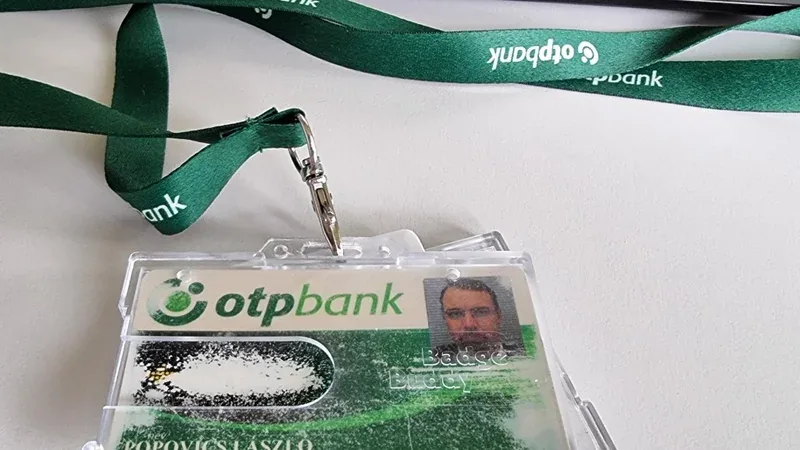
As you can see from the scratches on my ID card, I have been with OTP Bank for a long time. My story started in 2001 when I worked at SAP Hungary. At that time, OTP started its SAP implementation. I remember when I got an RS6000 system from IBM to install OTP's training system. The fun fact of this installation was that SAP Hungary relocated while I installed the system from Maros street to Csörsz street. I remember how I was sitting on the server and did the installation to complete on time. Mission accomplished on time! I moved to the next customer on the next day.
I didn't hear much from OTP until one evening at 10 pm I got a call from my boss. Unisys installed a terminal server license on the production cluster of the SAP R/3 system, and the cluster services disappeared thanks to the installation. All the services stopped.
My guidance was the following:
It doesn't matter if it takes a week, but please restore the system!
Luckily I found a trace file of the cluster. After my arrival in three hours, the system was running again! Thanks to this quick fix, I periodically visited OTP Bank as an SAP Technical consultant.
Until August of 2006, I worked at SAP Hungary, but after my work change, I moved full of my focus to OTP Bank as an External consultant.
Every year the system infrastructure change was a pain in the ass. It cost money like a fortune. Once the department leader told us, he will only believe those who can prove the performance increase of the replacement. I accepted the challenge!
I purchased a Mac Pro computer on my own and taken to the Bank.
We called my system silver arrow!
It was fun. It beat the current Enterprise-class system with an EMC storage three times! It didn't need exceptional cooling; it was quiet and fast like hell!
After the demonstration, the department leader asked me to design a replacement system for the production environment.
The infrastructure operation team was not satisfied with such a commodity system. They planned a replacement for six SAP systems.
Compared to the originally planned budget, I planned a replacement for all SAP systems with 40 workstations with a magnitude less cost. The CIO at that time said it was an easy decision to take. The good news: the performance increase was 700%. I planned the system for three years, but it operated for seven years. You can calculate how it affects the TCO.
I got feedback: It only works in small sizes. Challenge again accepted on my side. I started to plan a system for the largest system of the Bank. The data warehouse.
That time it was running on a SPARC Supercluster. Oracle sent me to an Exadata training. They expect that if I see how it works, I will be amazed and recommend the system. The result was different. I planned a custom-built configuration.
Results?
At 20% costs, the system performed multiple hundreds performance increase. Everyone was curious: how could I build a system that beat a system built by ten thousand engineers. The answer was easy: We access the same parts, but instant use faster than the approval process and testing inside an enterprise company.
Another significant challenge was developing a ticketing application called Service Desk. Initially, we developed on the SAP platform, but licensing was no longer a motivation as I moved away from SAP. I moved to Open Source technologies. The system served over 8K users in Hungary. The users created many million tickets. The replacement is still in progress; it may be finished by the end of the year, but the cost will not be the same.
One another story from the past is the landing system performance increase. We got a quote to increase the performance by 10% for a planned amount of budget. The day closing procedure endangered the opening of the Branches. The CIO needs an urgent solution. The only problem for the system (in 2014) it needed to build a new software environment which runs on the latest hardware. I proposed to build a custom Linux kernel for SLES9, which runs on the latest hardware. The results were excellent. For 10 percent of the original budget we decreased the day closing from 14 hours to 1 hour 57 minutes. The system again ran for many years in the same setup.
In 2017, I got an exciting invitation. Microsoft invited me to the CIO summit, where Microsoft invited 100 CIO worldwide. I was the first nominated person from Hungary to this conference. It was a great moment for me to feel the atmosphere around things that significantly impact our mother earth. At the next conference (MS Envision), I meet with Microsoft HoloLens technology. I saw the power at that time, and I felt how technology's power would affect our lives in the next decade.
We built two solutions: one about how holographic banking would work and holographic telepresence. To imagine how it looks like we made a video:
Parallel with the mixed reality; we have founded a Blockchain competence center. We also joined the Enterprise Ethereum Alliance, where I was seated in two groups. The Banking group and I also was the chair of the Multiplatform working group.